
MAY 7TH, 2026
Scoot Bolsters Fleet With 11 Airbus A320neo Family Aircraft
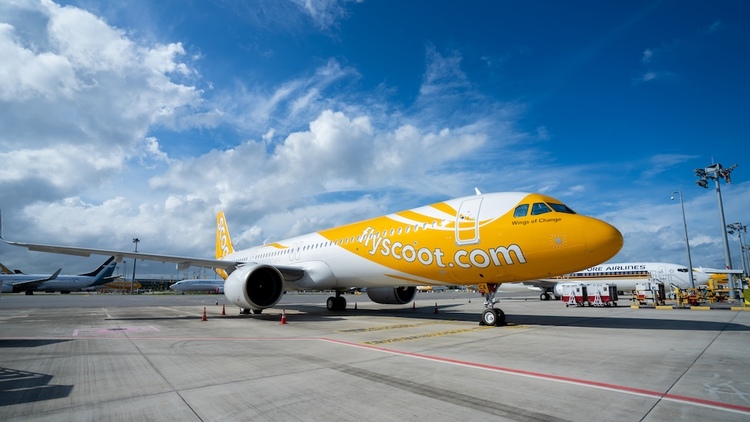
· Scoot has firmed up orders for five A320neo family aircraft, and exercised options to purchase an additional six
· Additional aircraft will support Scoot’s long-term growth strategy and meet the rising demand for air travel
· The new aircraft will be progressively delivered from 2028
Singapore – Scoot, the low-cost subsidiary of Singapore Airlines (SIA), today announced a firm order for five Airbus A320neo family aircraft. The airline also exercised options for an additional six aircraft, from its 2014 order with Airbus. The new aircraft will be progressively delivered from 2028.
With these 11 additional aircraft, which will be powered by the Pratt & Whitney PW1100G-JM (GTF) engines, Scoot’s total A320neo family orderbook will increase to 20 aircraft.
The new aircraft will feature 186 seats on the A320neo and 236 seats on the A321neo, all in a single class configuration. For more information, please see Annex A.
The additional A320neo family aircraft will expand Scoot’s capacity and route deployment flexibility across a five- to six-hour radius, enabling the airline to launch new services and optimise feed into the wider SIA Group network. These capabilities will enhance the depth and breadth of Singapore’s air connectivity between Southeast Asia, North Asia and beyond, reinforcing its standing as a premier global air hub. This growth also reflects confidence in the long-term outlook for air travel, particularly within the Asia‑Pacific region.
Over the years, Scoot has steadily expanded both its fleet and network, deepening connectivity with key markets through increased frequencies on high-demand routes, as well as boosting traffic on new routes. Since FY2022/2023, the airline has bolstered the SIA Group’s connectivity with 25 new destinations, including emerging non-metro cities such as Chiang Rai in Thailand and Phu Quoc in Vietnam, as well as long-haul destination Vienna in Austria. Of these new destinations, 16 are operated exclusively by Scoot out of Singapore.
By June 2026, Scoot will serve a total of 85 destinations, which accounts for about half of the destinations that Singapore currently connects to, via Changi Airport. Of these destinations, 37 are operated exclusively by the airline, underscoring Scoot’s role in opening new direct city links and stimulating traffic flows that might otherwise remain underserved.
Mr Leslie Thng, Chief Executive Officer, Scoot, said: “We expect travel demand to continue growing, particularly in the Asia-Pacific region, in the coming years. The range and capacity of the A320neo family aircraft will enable Scoot to expand and deepen the SIA Group’s network connectivity, providing the SIA Group with new growth opportunities and offering customers more seamless travel options.”
“Scoot’s mix of Embraer E190-E2 regional jets, Airbus A320 family narrowbody aircraft, and Boeing 787 family widebody aircraft allows us to operate an extensive network of flights. This covers short, medium, and long-haul routes, which complement the broader SIA network and further enhance Singapore’s position as a leading global aviation hub,” added Mr Thng.
Scoot currently operates a fleet of 63 aircraft, comprising 24 widebody Boeing 787 Dreamliners (including the -8 and -9 variants), 30 A320 family aircraft (six A320ceos, 12 A320neos, and 12 A321neos), and nine Embraer E190-E2 aircraft. As part of its fleet renewal programme and to maintain a more fuel-efficient fleet, Scoot plans to phase out its six A320ceo aircraft by 2028.
Operating a young and modern fleet is also one of the most effective ways for an airline to reduce carbon emissions. Since 2024, Scoot has added Embraer E190-E2 regional jets, which are among the quietest and most fuel-efficient aircraft in their class, to its fleet. In FY2025/2026, the airline replaced eight A320ceos with new-generation A320neos and A321neos. The A320neo family aircraft burn up to 20% less fuel, reducing carbon emissions and contributing to the SIA Group’s goal of achieving net zero carbon emissions by 2050.