JUNE 28TH, 2026
2026 Annual General Meeting of Shareholders: Vietnam Airlines Targets VND 138.899 Trillion in Revenue
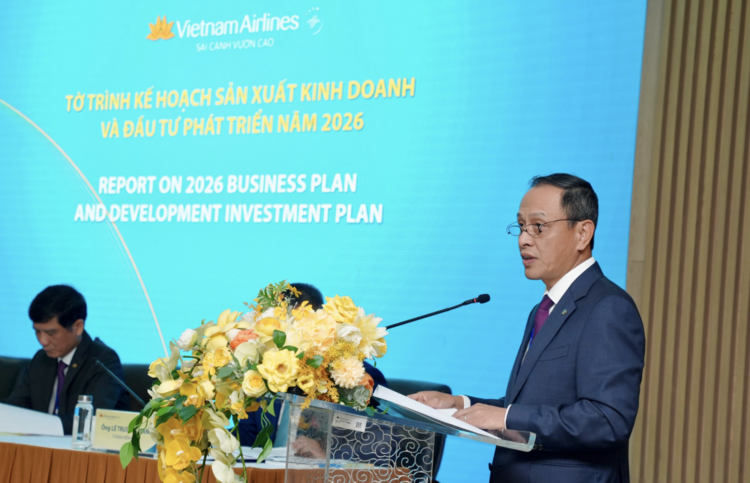
Hanoi, June 28, 2026 – Vietnam Airlines today held its 2026 Annual General Meeting of Shareholders, approving the audited 2025 financial statements, the Board of Directors’ report on 2025 operations, the 2026 business plan, and the development orientation for the year ahead.
Affirming Recovery Capacity and Strengthening the Position of the National Carrier
The year 2025 unfolded amid continued economic and geopolitical uncertainties worldwide. Despite these challenges, Vietnam Airlines maintained its growth momentum and delivered strong business performance. The airline recorded consolidated revenue of VND 123.858 trillion and consolidated profit after tax of VND 7.607 trillion.
During 2025, Vietnam Airlines operated 156,200 flights, carrying 25.65 million passengers and transporting 340,200 tonnes of cargo. Operational efficiency continued to improve, with average aircraft utilization reaching 11.8 flight hours per aircraft per day, an 8% increase year-on-year.
The airline’s route network was fully restored and further expanded. Vietnam Airlines resumed and launched 14 international routes, bringing its total network to 113 routes connecting 22 domestic destinations and 39 international destinations across 22 countries. The airline continues to serve as a leading force in air transportation within Southeast Asia.
Key business areas, including flight operations, engineering, ground services, cargo transportation, and e-commerce, all delivered positive results. Subsidiaries and member companies such as VAECO, SKYPEC, VIAGS, NCTS, TCS, NCS, and VACS continued to play integral roles within the Vietnam Airlines Group ecosystem, making significant contributions to the Group’s consolidated business performance.
The year also marked important milestones in strengthening the Vietnam Airlines brand, with the airline receiving 30 domestic and international awards, including three Certificates of Merit from the Prime Minister of Vietnam. These recognitions reflect the airline’s continued commitment to service excellence, management innovation, and sustainable development.
At the same time, 2025 represented another significant step in Vietnam Airlines’ journey to redefine the customer experience as it works toward achieving the five-star airline standard by 2030.
In line with the spirit of Resolution No. 57-NQ/TW on breakthroughs in science and technology development, innovation, and national digital transformation, Vietnam Airlines implemented a range of initiatives to enhance the customer journey. These included the introduction of in-flight internet services, the synchronization of operations and passenger services at Terminal 3 of Tan Son Nhat International Airport, and the application of biometric technology through VNeID in the passenger check-in process.
In addition, the development of the airline’s new commercial website remains one of the flagship projects within its digital transformation strategy. These initiatives not only optimize operational processes but also reduce service times while delivering a more seamless and modern travel experience for passengers.
Proactively Responding to Market Volatility
The year 2026 marks the first year of Vietnam Airlines’ long-term development strategy for the 2026–2035 period, against the backdrop of an increasingly complex and unpredictable global economic and geopolitical environment, particularly the sharp volatility in fuel prices resulting from geopolitical conflicts. At certain points, Jet A1 fuel prices exceeded USD 200 per barrel, placing significant cost pressures on airlines worldwide.
In response, Vietnam Airlines has proactively developed flexible operating scenarios, optimized its network across key markets, maintained strict cost controls, and further improved fleet utilization efficiency. In line with the policies and strategic direction of the Party and the Government, the airline remains committed to achieving its 2026 business targets, sustaining growth momentum, enhancing competitiveness, and contributing to macroeconomic stability, trade, tourism, and international integration.
During the first half of 2026, Vietnam Airlines launched and announced several new international routes to Amsterdam, Phuket, and Colombo, while increasing frequencies on services to Singapore, Manila, Moscow, Kaohsiung, Melbourne, and Sydney to meet growing passenger demand.
The airline is simultaneously implementing a range of strategic initiatives to strengthen operational capacity, expand its market presence, and improve business efficiency. Fleet renewal remains a key priority, with continued implementation of the investment project for 50 new-generation narrow-body aircraft, which are expected to be delivered between 2030 and 2032.
At the same time, Vietnam Airlines is moving forward with plans to lease 20 narrow-body aircraft to meet operational demand during the 2027–2028 period and expects to commence operations of its first dedicated freighter in the third quarter of 2026. The airline is also continuing to invest in technical infrastructure at strategic airports, including Long Thanh International Airport.
In 2026, Vietnam Airlines further strengthened its regional standing by being named among the Fortune Southeast Asia 500 for the third consecutive year, ranking among Southeast Asia’s 100 largest companies. Its continued rise in the Fortune Southeast Asia 500 ranking reflects the effectiveness of the airline’s sustainable growth strategy, strong corporate governance, and adaptability in an evolving market environment.
Most recently, Cirium, a strategic partner of the International Air Transport Association (IATA), ranked Vietnam Airlines third among the top 10 most punctual airlines in the Asia-Pacific region in 2026, with an on-time arrival rate of 87.77%, underscoring the airline’s operational reliability amid continued growth in travel demand.
Accelerating Digital Transformation and Sustainable Development in a New Growth Phase
For 2026, Vietnam Airlines targets carrying 27.73 million passengers and transporting 361,400 tonnes of cargo, representing year-on-year increases of 8.1% and 6.2%, respectively. Consolidated revenue is projected to reach VND 138.899 trillion, up more than 12% compared to 2025.
Digital transformation remains a strategic priority in Vietnam Airlines’ sustainable development roadmap. The airline is building a digital airline model aligned with international standards while investing comprehensively in technology infrastructure through the VNA Private Cloud, VNA Data Platform, and Customer Data Platform to enhance corporate governance, optimize revenue, and improve customer experience. In parallel, the VNA AI 2.0 program and the Lotus AI Agent ecosystem are expected to drive further improvements in productivity and operational efficiency.
Alongside digital transformation, Vietnam Airlines is implementing a sustainability roadmap based on ESG principles, with specific objectives to reduce carbon emissions, optimize fuel efficiency, and advance research into the application of Sustainable Aviation Fuel (SAF). The airline also continues to focus on enhancing service quality, developing a highly skilled workforce, fostering a modern corporate culture, and strengthening governance in line with international best practices, all in pursuit of its goal of becoming a globally recognized five-star airline by 2030.
Guided by its commitment to sustainable development, Vietnam Airlines will continue to uphold its role as Vietnam’s national carrier and the country’s leading air transport provider, delivering high-quality services while contributing to socio-economic development, strengthening Vietnam’s connectivity, and enhancing the nation’s position on the global aviation map.